Table Of Contents
- The Objective of Texas Holdem online is to make a 5-card hand using 2 of your private cards and 3 of the community cards. This is done through a series of betting rounds, and in the final round, the player with the highest-ranked hand and the best Texas Holdem poker strategy wins.
- We hope that our recommendations and guide concerning the strategy for Casino Texas Hold'em will help you to achieve the best results. However do not start playing with real bets. First, you should master the ways to make right decisions at all stages of the table game and avoid mistakes.
Texas Holdem Strategy. Texas holdem poker is the most popular card game in the United States. It’s also hugely popular in Europe and other countries. Omaha has a firm foothold in other countries, too, but Texas holdem has a big following just about everywhere. If you want to be a winning poker player, it’s almost a given. Choosing the right Texas Holdem strategy When you know which hands to play, you should just concentrate on playing tight-aggressive poker strategy postflop and using your position. This means that instead of calling you should be raising most of your holdings when you decide to play. Three strategies for Texas Hold'em Poker are most important and more influential than all others. Combining discipline, patience and anticipation is the greatest Texas Hold'em Strategy, capable of launching you beyond the opponents at your table and giving you a real chance of winning.
Ultimate Texas Hold’em is one of the most popular live and online casino games for poker players.
One big reason is that if you know what you are doing, the game will feature one of the lowest house edges of any casino game.
Half the battle is just knowing the basic rules of Texas Hold’em, particularly the hand rankings which are common in most poker games.
How about some Ultimate Texas Hold'em?Head to this online casino for an exciting session of Ultimate Texas Hold'em Poker. Massive welcome bonus available!
About Ultimate Texas Hold’em
Ultimate Texas Hold’em was developed by Roger Stone of Shuffle Master and similar formats are also known under other names including Heads Up Hold’em distributed by Galaxy Gaming.
If you have learned the basic rules of Texas Hold’em, you will quickly pick up on how to play Ultimate Texas Hold’em with the hand rankings and each player holding two hole cards being the same in both games.
As this is a casino, the house will have an edge. Players should experience plenty of winning sessions, but unlike regular Texas Hold’em, players are competing against the house and not a player.
What you might not know about Ultimate Texas Hold’em is that if it is played correctly it has one of the lowest house edges among any casino game at around 2%.
Reasons to play Unlimited Texas Hold’em
- Low house edge of around 2% when following basic strategy
- Fun to play alone or with friends
- Similar to Texas Hold’em
- Can play for just a few minutes
- Potential to win big
Read on to learn more about the rules of Ultimate Texas Hold’em and how to optimize your play to reduce the house edge to almost nothing.
How to Play Ultimate Texas Hold’em
Usually, you can play Ultimate Texas Hold’em at a casino with up to six players and a dealer (also known as the house).
The game utilizes a standard 52 card deck. Although online, you will find many heads-up games where you will compete one-on-one against the house.
Each player must post an ante and a blind before each hand begins. You will see posted minimums and maximums. Keep in mind that your bet must be the same for both of these and that it will also serve as a base for other bets as the hand progresses.
Therefore, we recommend when first getting your feet wet to bet as small as possible to further the power of your bankroll. You can always adjust with higher bets once you feel comfortable that you have optimized your game.
There are also optional side bets which can vary from casino to casino including the Trips bet you can place before the hand is dealt which we will get into later.
Two cards are dealt to each player and the dealer after the initial Ante and Blind bets are placed.
Remember, hand rankings are the exact same as Texas Hold’em.
Check out our detailed description of how to play Texas Hold’em to brush up on Hold’em hand rankings.
You can decide to bet three times or four times the Ante and place the bet into the Play box or check before the flop comes.
A flop is then dealt and you will have an option whether to bet two times the Ante bet or check once again.
The turn and river are dealt one after the other and you will have one last option on whether to place a bet equal to the Ante in the Play box or to fold the hand.
There is a bit of basic strategy that you should either memorize or have a chart with you while playing to best optimize when to bet in the Play box, when to check, and when to fold.
Players that folded after the river was dealt will automatically lose their Ante and Blind bet.
Those remaining in the hand will turn over their cards as will the dealer. If you have a better Texas Hold’em hand than the dealer you win the Play bet for the same amount as bet.
The Blind bet can also only be won if you have won the hand. Assuming this is the case, it is paid out on a sliding scale and can be worth as much as 50 to 1 for a straight flush. However, if you don’t have a straight or better, you will simply just get your bet back as a push.
Here is a look at the potential different payouts of the Blind bet which can vary slightly from casino to casino.
| Hand | Payout |
|---|---|
| Royal flush | 500 to 1 |
| Straight flush | 50 to 1 |
| Four of a kind | 10 to 1 |
| Full House | 3 to 1 |
| Flush | 3 to 2 |
| Straight | 1 to 1 |
| All Other | Push |
The Ante bet is a bit trickier. If the dealer doesn’t qualify with at least a pair, you will get your Ante refunded as a push. This is the case whether you had a better hand or not, as long as you didn’t fold your hand.
If the dealer qualified with a pair or better, you will need to beat the dealer in order to win this even money bet.
Feeling ready for some Ultimate Texas Hold'em?Head to this online casino for an exciting session of Ultimate Texas Hold'em Poker. Massive welcome bonus available!
Best Ultimate Texas Hold’em Strategy
You should quickly get the hang of the rules of Ultimate Texas Hold’em by reading the rules above and potentially watching a few hands being played.
However, we don’t recommend that you hop right into Ultimate Texas Hold’em until you learn some basic strategy as it could turn out to be a nightmare to play based on gut feeling.
For example, if you decide to blindly bet four times your bet in the Play box every hand, you will be subject to a house edge of around 14%. Likewise, if you aren’t betting at the right times, you will also increase the house edge.
You should always bet the maximum allowed in the Play box before the flop when you bet. The following chart should serve as a guide to when you should place a bet in the Play box and when you should fold preflop.
| *A | K | Q | J | T | 9 | 8 | 7 | 6 | 5 | 4 | 3 | 2* | |
| A | B | B | B | B | B | B | B | B | B | B | B | B | B |
| K | B | B | B | B | B | B | B | B | B | B | S | S | S |
| Q | B | B | B | B | B | B | B | S | S | C | C | C | C |
| J | B | B | B | B | B | S | S | C | C | C | C | C | C |
| T | B | B | B | B | B | C | C | C | C | C | C | C | C |
| 9 | B | B | B | B | C | B | C | C | C | C | C | C | C |
| 8 | B | B | B | S | C | C | B | C | C | C | C | C | C |
| 7 | B | B | S | S | C | C | C | B | C | C | C | C | C |
| 6 | B | B | S | C | C | C | C | C | B | C | C | C | C |
| 5 | B | B | C | C | C | C | C | C | C | B | C | C | C |
| 4 | B | S | C | C | C | C | C | C | C | C | B | C | C |
| 3 | B | S | C | C | C | C | C | C | C | C | C | B | C |
| 2 | B | S | C | C | C | C | C | C | C | C | C | C | C |
- B = Bet four times in Play box
- C = Check
- S = Bet four time in Play box if suited, otherwise check
The strategy gets a little easier if you didn’t bet preflop. You should bet two times on the flop in the Play box if you have two pair or better, a hidden pair, or a flush draw with a hidden ten or better. A hidden pair means that there isn’t a pair on the board and you are using one or more of your hole cards to create that pair.
River strategy can be particularly tricky. It is easy to memorize what to do but not always easy to make the optimal play in real-time.
Place a bet of equal to your Ante bet if you have a hidden pair or better or the dealer has less than 21 outs to beat you. After some practice, determining how many outs the dealer has to beat you will become more second nature but take your time at first as it’s your money and the game typically doesn’t have a time limit with the exception of some multiplayer online games.
Side Bets
Side bets are usually a way for online and live casinos to extract a little extra money per hand, spin, or dice roll at extremely bad odds.
This isn’t necessarily the case in Ultimate Texas Hold’em with its optional Trips bets that you will see on just about every table.
It all comes down to the odds that they are paying on the Trips bet as it could be an under 1% advantage for the house under optimal conditions if you can find them.
Your Trips bet can be a different amount than your Ante and Blind bets and is only paid if you wound up with trips or better. In just about every case you are paid 3 to 1 for trips or a set and 50 to 1 if you nail down the elusive Royal Flush.
What you should be looking for if considering to place a Trips bet is a bet table similar to below which gives the house less than a 1% advantage.
| Hand | Payout |
|---|---|
| Royal Flush | 50 |
| Straight Flush | 40 |
| Four of a Kind | 30 |
| Full House | 9 |
| Flush | 7 |
| Straight | 4 |
| Trips/Set | 3 |
| All Others | -1 |
Other payout tables might look similar with a Royal Flush paying 50 to 1 and trips paying 3 to 1. However, some smaller differences in the middle of the pay table can make a big difference.
For example, the pay table below would give the house a more than 6% advantage and should be avoided at all costs.
| Hand | Payout |
|---|---|
| Royal Flush | 50 |
| Straight Flush | 40 |
| Four of a Kind | 20 |
| Full House | 7 |
| Flush | 6 |
| Straight | 5 |
| Trips/Set | 3 |
| All Others | -1 |
There are other side bets that online and live casinos make available including hole card bonuses and bad beat jackpots.
In general, any side bet that isn’t the Trips bet gives the house a huge house edge and therefore should be avoided.
One exception might be in the case of progressive jackpots where the jackpot is high enough to make the house edge low and, in some cases, even give the player an advantage. One pitfall even here is that the jackpots are few and far between and thus will likely cause you money unless you hit at least one jackpot in your lifetime.
Conclusion
Ultimate Texas Hold’em is a fun online and live casino game that can be played whether you have a few spare minutes or want to grind a long session.
The rules are easy to learn and before long it is possible to master the strategy of the game to reduce the house edge to approximately 2% in the base game.
While it isn’t likely you will become a long-term winner in this game without a bit of luck, it is more likely than many other games to have winning sessions and go on runs to win a chunk of change.
The promotion presented on this page was available at the time of writing. With some Casino promotions changing on daily basis, we suggest you to check on the site if it still available. Also, please do not forget to read the terms and conditions in full before you accept a bonus.Texas holdem poker is the most popular card game in the
United States. It’s also hugely popular in Europe and other
countries. Omaha has a firm foothold in other countries, too,
but Texas holdem has a big following just about everywhere.
If you want to be a winning poker player, it’s almost a given
that you’ll need to learn at least the basics of Texas holdem
strategy. After all, you’ll be able to find more games (and more
weak players) at those tables than anywhere else.
Texas holdem strategy is a huge subject, too. We have
literally dozens of pages on various subtopics related to the
subject. Below we provide brief introductions to many of the
strategic concepts you need to understand. In almost every
instance, we link to a comprehensive page devoted to that
concept, too.
Low Limit Strategy vs High Limit Strategy
The strategies you use when playing for lower limits differ
from the correct strategies at higher limit games. As a general
rule—and make no mistake, there are exceptions—you’ll find more
unskilled players at the lower limits than you will at the
higher limits.
For one thing, it means that a more direct approach to the
game will often be rewarded. We can sum up this direct approach
in 2 sentence:
Get the hands. Then bet the hands.
First of all, it means don’t bother trying to play second
rate hands. Don’t spend a lot of time trying to bluff. Unskilled
players have a hard time laying down hands, and bluffing only
works if your opponents are willing and able to fold.
Second, it means that when you do get good cards, start
putting your money into the table. Bet or raise. Don’t
cold-call. Don’t check. Get paid off for your hands.
Finally, keep in mind something called “the schooling
effect”. Lots of players at this level are calling stations.
This means that if you have a speculative hand, like suited
connectors, you can often get enough other players into the pot
to get paid off big when you hit a strong flop.
When you start playing in higher stakes games, you have to
get more creative in order to win. Skilled players are likely to
notice if you’re playing ABC poker, and they’ll be able to take
advantage of that. So you’ll have to learn how to mix it up.
Microlimit strategy is another aspect, too. The same
strategic concepts that apply to microlimit games, only more so.
Blind Play
It’s important to know how to play from the blinds. In fact,
the blinds are some of the most important positions in a Texas
holdem game. Correct blind strategy is a complicated subject,
too.
Here are some of the basics:
What most players concern themselves with is defending their
blinds. A situation that comes up often is that everyone will
fold before the action gets to the player before the blinds, and
you’ll wind up with some aggressive player who will raise into
you when you’re in the blinds. They might be holding nothing.
You’ll need to be paying attention to your opponents’
tendencies when deciding whether or not they’re just trying to
steal your blinds. It’s okay to fold when someone raises you in
the blind, especially if you have junk.
But it’s not okay to fold EVERY time someone raises your
blind.
Sometimes you need to call and then raise on the flop.
And sometimes you need to re-raise their raise before the
flop.
Some of this depends, too, on what cards you’re holding. If
you have a solid hand (like KK or AA), and someone raises into
your blind, don’t be afraid to try to get them all in.
In fact, premium hands almost play themselves in this
situation. As long as you avoid slow-playing, you’ll be fine.
It’s the more speculative opening hands, like low pairs and
suited connectors, where you have to start making decisions.
And the best guideline to making those decisions is your
knowledge of your opponents’ playing tendencies.
Playing Styles
If you’ve done ANY reading at all about playing styles in
Texas holdem, you’ll know that players are often categorized
according to how many hands they play and according to how often
they raise or bet.
- Players who play a lot of hands are called “loose”, and
players who play only their best hands are called “tight”. - Players who bet and raise a lot are called
“aggressive” - Players who call and check a lot are called “passive”
Most experts agree that tight-aggressive play is the winning
formula, especially at lower levels. This means you should focus
on playing good hands, and betting and raising when you have
them.
You’ll also find plenty of players who do well with a
loose-aggressive style. They play a lot of hands, but they bet
and raise so often that they win a large number of pots without
a contest.
If you win enough smaller pots, you can use that money to
“freeroll” your way into hands where you have more speculative
holdings. This is an especially important strategy to think
about when you get into higher limit play.
Guide to Playing Styles
Odds and Probability
Understanding the odds and probability involved in Texas
holdem are a critical skill. The most important aspect of this
to understand has to do with comparing the odds of hitting your
“outs” and the pot odds being offered.
The first concept to understand is the concept of “outs”. An
“out” is a card that will complete your hand and give you the
winning hand.
You have 2 cards in your hand, both hearts. And the flop also
has 2 hearts on it. So you have 4 cards to a flush.
There are 13 hearts in a deck of cards. 4 of them are already
out there, so 9 of them are left in the deck. And there are 47
cards left in the deck.
Those 9 cards are your “outs”. Those cards will give you what
you need to have a winning hand. (Assuming that you have the top
flush at the showdown, anyway.)
You can compare those odds to the odds that the pot is
offering you to decide whether or not to call a bet.
In this case, the odds of hitting the hand you want are 9/47,
or about 1/5, or 4 to 1. But you get 2 chances at it.
Suppose there’s $100 in the pot, and it only costs you $10 to
call and stay in the pot. You’ll lose 4 times for every time you
win, but you’ll win 10 to 1 on the 5th time. Overall that’s a
profitable play.
Comparing pot odds to the odds of hitting your hand is just
one example of probability in action during a Texas holdem game.
Another factor expert players consider is how likely it is
that other players will fold. You have to take this into account
when making decisions, too.
If you’re playing against a super-tight opponent in the
blinds, and you estimate that there’s a 90% chance he’ll fold
against any raise, raising is almost always the correct play
there.
But you can’t estimate these kinds of odds unless you’re
playing close attention to your opponents’ playing tendencies.
Preflop and Postflop Playing Strategy in Texas Holdem
The first 2 cards you’re dealt in a hand of Texas holdem are
your hole cards. That’s considered your “preflop” hand, and you
need a strategy for how to play them. We’ve seen estimates that
suggest you can break even if you master preflop play, even if
you’re only an average player after the flop.
We mentioned a tight aggressive approach, earlier. This holds
especially true when playing before the flop. It’s also
important to take into account position when you’re playing
preflop.
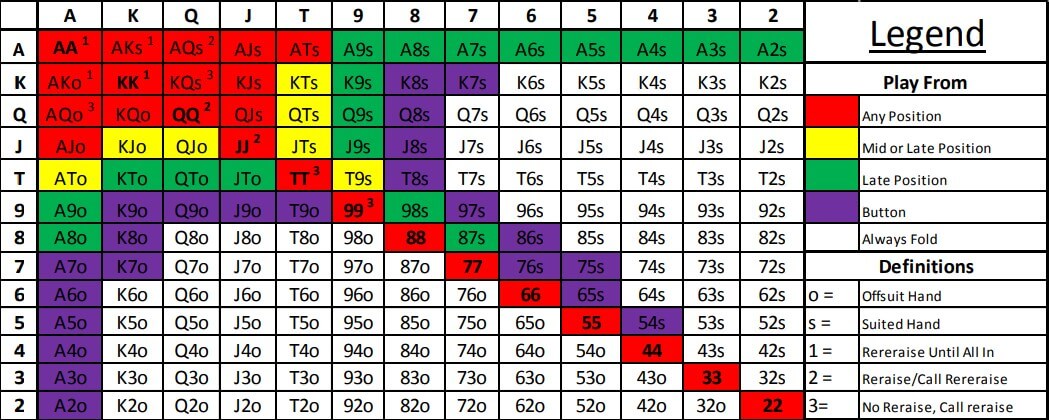
It’s easy to find a lot of suggestions about which hands you
should and shouldn’t play from various positions before the flop
in holdem. Our favorite way to think about these hands is to
categorize them.
Here are some categories of preflop hands to think about:
High Pairs
High pairs are 2 cards of the same rank that are ranked 10 or
higher. The higher they’re ranked, the better. Aces and kings
are super hands to play preflop, but the value of these pairs
drops dramatically when you’re looking at queens, jacks, or
tens.
Most experts recommend raising from any position with a pair
of aces or kings regardless of what your opponents have done.
But you need more judgment when dealing with a pair of queens or
jacks. If you’ve seen 3 players before you bet and raise
repeatedly, those queens might be an underdog. Some of this
depends on your opponents’ tendencies, too.
Smaller Pairs
Smaller pairs are legitimate starting hands, too, but you’re
hoping for them to improve on the flop. The higher the ranking
of the lower pair, the better off you are. A pair of 9s isn’t
terrible, but a pair of 2s borders on worthless. That’s because
even if you hit another 2 on the flop and make your 3 of a kind,
there are a lot of other potential 3 of a kinds that could beat
you.
Suited Connectors
Suited connectors can be some of the most interesting
starting hands to play. These are 2 cards of the same suit which
are also close in rank. The 10 and J of spades would be
considered suited connectors. These are speculative hands,
because you need them to improve in order to win. But they have
lots of potential—you could make a flush or a straight, for
example. And if the suited connectors are high enough in rank,
you might even wind up with a big pair.
Big-Little Suited
Big-little suited is even more speculative, because you’re
missing some of the straight possibilities. The higher the
cards, the better. An AK suited or an AQ suited is almost as
good as a pair of queens or jacks, but an A4 suited is pretty
speculative. Everything needs to go right in order for you to
win a hand with those cards.
Best Texas Holdem Poker Free
The tendency is to want to bet and raise with your really
strong hands before the flop, but with more speculative hands,
you want to check and call, hoping to get into the hand cheap
with a lot of other players so you’ll get paid off if you hit
your hand.
Who has acted before you and what they did is also super
important to your decision here.
We have entire sections devoted to preflop play, starting
hands, and starting hand charts. All of these topics are closely
related.
Guide to Postflop Strategy
Tournament Strategy and Sit n Gos
Tournaments require a different strategy than ring games,
because the goal is to be one of the last men standing in a
tournament. In a ring game, you can play forever, and the chips
are worth what the chips are worth.
But in a tournament, the values of the chips change as the
game continues. The blinds increase on a regular basis during a
tournament, too, so your strategy has to change based on the
size of your stack versus the size of the blinds.
Some Texas holdem players specialize in tournaments. Others
prefer ring games. The thing about tournaments is that they have
a higher variance. Some players like this, but others prefer a
steadier stream of winnings.
Here’s what we mean:
You might play in a dozen tournaments with an average buy-in
of $100 each. You might only place in the money in one of them,
but you also might win $4000 in that one, so you’re profitable.
But it took you a while to become profitable.
A ring game player, on the other hand, might play steadily
and win $1000 a month consistently 5 months out of 6, having a
losing money only occasionally.
Your temperament will determine which is better for you.
We have sections about tournaments in general and about sit
in go tournaments specifically, too. (A sit n go is a specific
type of tournament that’s most prevalent on the Internet.)
Psychology, Tilt, Tells and Texas Holdem Strategy
The psychology of Texas holdem covers multiple subjects. For
one thing, understanding what your opponents’ emotional
tendencies are can be a big edge in any Texas holdem game. If
you know that one player likes to be the sheriff (he calls a lot
of hands to make sure you’re not winning money by bluffing),
you’ll know the best way to extract the most money from him.
If you know that a player makes bad decisions when he’s mad,
and if you notice what makes him mad, you can subtly manipulate
his anger to take advantage of those bad decisions. In fact,
this is a serious phenomenon called “tilt”.
A player who is tilting is putting money into the pot because
of anger, not because it’s the mathematically correct play. It’s
easy to take advantage of players with that tendency.
Understanding your own psychology is just as important. You
have to know when you’re on tilt. You also need to know how to
avoid tilt to begin with. If you realize you’re on tilt, it’s
time for a break. You might even need to take the rest of the
night off from playing poker.
Tells are another aspect of poker psychology. Tells are
subtle physical clues as to what kinds of cards your opponents
are holding. Most players have tells. And most players aren’t
good at spotting them.
Entire books have been written about spotting tells at the
poker table. Tells are only one aspect of Texas holdem strategy,
but they’re a “sexy” aspect of it. Some players, especially
beginners, spend too much time and energy thinking about and
trying to spot tells.
Guide to Tilt Strategy
Guide to Tells Strategy
Texas Holdem Tips and Advice
We have pages devoted to Texas holdem tips and Texas holdem
advice, too. These are a great way to get introduced to some of
the more basic concepts in holdem.
We can provide you with a couple of quick pieces of advice
and a few tips, here, too:
You’ll find a lot of really great books with
in-depth treatments of poker strategy. The Theory of Poker by
David Sklansky is essential reading for any poker player,
regardless of which game you’re playing. Super/System by Doyle
Brunson (and others) is also worth reading, especially the
sections about limit and no limit holdem. Anything by Ed Miller
is worth your time, too. And those are just for starters. Expert
Texas holdem players are almost always well-read Texas holdem
players.
If you’re playing online, you should use the
note-taking function in the poker room software to take some
notes on your opponents. If you’re playing live, you should keep
a journal and write about what’s going on. You should keep book
on your opponents, but you should also track your results and
how you got them. Texas holdem is a thinking person’s game. Few
things clarify your thoughts on a subject better than writing
about it.
Good players bet and raise. Weak players
check and call. You can find loose aggressive players who are
profitable, and you can find tight aggressive players who are
profitable. What you can’t find are passive players who are
profitable. Loose passive players are calling stations, and they
lose money right and left. Tight passive players are rocks, and
they lose money, too—just more slowly than calling stations.
If you’re a beginner, you probably need to play
fewer hands. As you grow more proficient, you can play more
hands. You might even be the type of player who can succeed as a
loose aggressive player. But we don’t recommend that as a
starting goal. That’s something to experiment with once you’ve
mastered tight aggressive play.
Best Strategy Texas Holdem Poker Wsop
If you’re new to the game, play for stakes you
can easily afford. Microlimits online are a great place to
start. If you’re playing live, start with the lowest stakes
limit games you can play. You can move up in stakes as your
bankroll grows and as you become more confident in your skills
as a player.
Find some buddies who can talk intelligently about
playing Texas holdem, even if they’re only online buddies. You
can find excellent discussions of poker strategy on various
forums. Two Plus Two is one of our favorites, although they’re
not as friendly toward newcomers as we would hope.
Being detached from the outcome of each hand is a
crucial mental skill that many players can’t master. If you’re
getting mad about results all the time, you’re going to have a
hard time playing correctly. How do you become detached from the
outcomes? Pat yourself on the back for making the correct play,
regardless of the results. You might also spend some time
studying meditation techniques. These can help you get your
emotions under control.
There are no advantages to being drunk at the
poker table. Alcohol impairs your judgment, period. It’s better
to just stay sober. We know players who “pretend” to be drunk at
the table in order to take advantage of other players. But most
of them are not really pretending. If you smell like booze,
you’re probably drunk.
A lot of players try clever fancy
moves at the poker table because they’ve watched too many
episodes of World Poker Tour. Here’s the secret about those
shows: they’re heavily edited. Most poker hands are boring in
the extreme. They show you the most exciting ones. But it’s easy
to get confused and think poker is played one way based on what
you’ve seen on television, but it ain’t necessarily that way in
real life.
We mentioned this before, but Texas holdem is a
thinking person’s game. If you want to succeed, you need to pay
attention to what’s going on, even when you’re not involved in
the hand—which is going to be most of the time, because most of
the time you won’t have playable cards. Think about the numbers.
Think about what cards the other players might have when they’re
making their decisions. This will go a long way toward improving
your game.
Our best Texas holdem advice?
Don’t get suckered into thinking you’re a great player just
because you’re on a winning streak. This is the biggest mistake
most new players make. Texas holdem is a high variance game.
That means luck is a big factor.
Advanced Strategy
We have an entire section devoted to advanced strategy for
Texas holdem players. We won’t get into a lot of detail about
advanced tactics on this page, but we will say that advanced
strategies only start to matter when you’re playing other expert
players.
You don’t need advanced strategy to beat novice players.
Solid ABC poker is good enough to beat novice players.
But once you start dealing with thoughtful, expert players
with lots of experience, you have to start taking things like
game theory into account. You have to start bluffing and
semi-bluffing occasionally. Deception becomes more important.
(We also have a section explaining Texas holdem and game
theory.)
Raising with your good hands and folding your bad hands is
good enough to win when you’re playing novices, but when you’re
dealing with advanced players, you need a more multi-dimensional
approach.
Cheats, Cheaters, and Cheating
We don’t recommend cheating at Texas holdem. It’s an easy
enough game to beat if you play honestly—if you’re willing to do
the work of becoming an expert player. And the risk-reward ratio
for cheaters is awful.
In fact, we’re firmly convinced that cheating at gambling is
a bad idea for lots of reasons. Karma is one of the significant
ones.
If you don’t want to get cheated, don’t try to cheat other
players. Being a good player is more fun and more satisfying,
anyway.
And there’s not much risk involved in becoming an expert
player.
Bluffing and Semi-Bluffing
New players think that bluffing is a more important part of
Texas holdem strategy than it actually is. There are several
things to keep in mind about bluffing. Most of them just flat
out have to do with the math.
Let’s look at an example of a situation where you might want
to bluff:
The first player to act bets. The 2nd player to act raises.
Player 3 re-raises. A couple of players fold, so now it’s your
turn to bet. (This is preflop.)
Trying to bluff these 3 players doesn’t make a lot of sense
from a mathematical standpoint. They’ve all indicated a strong
hand—sure, one of them might be bluffing, but all 3 of them?
Unlikely.
After all, the good cards have to be somewhere.
Let’s look at another situation. You’re the last person to
act before the blinds, and everyone has checked. (Again, this is
preflop.)
You fire off a raise.
But you don’t have good cards. You’re just hoping that
everyone else has weak cards.
What are the odds that the player in the small blind, the
player in the big blind, and all the other players who checked
have weaker hands than you do? And even then, what are the odds
that if they all have weaker hands that they’re all going to
fold? Or that some of them won’t improve?
You then have to compare those odds with how much you’re
going to get paid off if they do all fold. There would have to
be a lot of money in the pot.
Let’s say you assume that each of these 4 players at the
table have a 50% chance of folding in the face of your raise.
50% X 50% X 50% X 50% = 6.25%. That’s the probability that
they’ll all fold in the face of your raise. That’s about 15 to
1.
So to make that a profitable bluff, you’d need to have at
least 15 units in the pot for every unit you bet. With that much
money in the pot, even some of the less sophisticated players
are going to stay in just in case their longshot comes through
for them.
Semi-bluffing, on the other hand, often makes a lot more
sense. This is when you bet and/or raise even though you
probably don’t have the best hand, but you still have a chance
at drawing to the best hand.
An example of this is when you have 4 cards to a flush on the
flop. You figure your opponent has a high pair. He’s the
favorite to win, but when you add together the chance that
you’ll outdraw him with the chance that he’ll fold in the face
of your bet/raise, you have a positive expectation situation.
You have a 33% chance of hitting your flush (roughly). But
suppose you also have a 30% chance of him folding. You don’t
need a lot of money in the pot to make that a bet worth making.
We have an entire page devoted to the subject of bluffing and
semi-bluffing, too.
Cash Game Strategy
Earlier we mentioned that there’s a difference between
tournament strategy and cash game strategy. We want to reiterate
that here and point you toward that section of our site.
Your goal when playing in cash games is to maximize the
amount of money you win per hour. That might seem obvious, but
when you’re mapping out a specific strategy for a specific game,
you need to start with what winning looks like. In cash games,
it means maximizing the amount won on average per hour.
Contrast this with strategy during a tournament. Your goal
isn’t to maximize the number of chips you win per hour. Your
goal is to maximize your return on investment on the entry fee.
The chips have no real value. Another way to look at it is to
say that the value of the chips varies based on where you are in
the tournament.
If you’re “on the bubble”, which means that almost everyone
has been eliminated except for the players who are going to land
in the money, a short stack of chips might be “worth” a lot more
than your starting stack of chips.
This has interesting implications for your playing strategy.
Coaches, Coaching, Trainers, and Training – Where to Get
Texas Holdem Lessons
We’re not convinced that everyone needs a poker coach.
Coaching is probably not a bad idea if you’re serious about your
game, though. The distinction between a Texas holdem coach and a
trainer is probably not great—we don’t know of any training that
differs in any significant way from coaching. In fact, we’re
confident in saying that the two words are synonymous in this
context.
Where to get Texas holdem lessons?
We’re not convinced that you need them, but if you’re looking
for a poker coach who gives lessons, we suggest taking a look at
some of the more reputable poker forums online. Get to know some
of the players there, develop some relationships, and when you
start to get comfortable with some of these folks, ask someone
for a recommendation.
We offer more observations and tips about finding poker
coaches and lessons on a page devoted specifically to that
topic.
When to Fold in Texas Holdem
Really you can ask multiple questions about betting options
in Texas holdem:
- When should you fold?
- When should you bet?
- When should you call?
- When should you check?
- When should you raise?
- When should you bluff?
None of these questions, including “when should you fold”,
have definitive answers. Some situations are clear folds—if
you’re out of position before the flop and you have 27 offsuit,
you should probably fold. If you’re in late position facing lots
of callers, and you have pocket aces, you should almost
certainly raise.
The goal is to get your money into the middle of the table
when it’s a positive expectation move to do so.
The other goal is to avoid putting money into the pot when
it’s a negative expectation move to do so.
We go into a lot more detail about when to fold in Texas
holdem on our main page.
Conclusion
Texas holdem is a lot of fun. Luck’s a big factor, but Texas
holdem strategy is the difference between long term winning and
long term losing.
We’re constantly expanding this section. Entire books have
been written about some of these concepts. We’ve tried to
provide comprehensive explanations of each off these concepts,
but we might have left out a detail here or there.
Best Strategy Texas Holdem Poker Rules
If you see a mistake we’ve made, or if you think we should
add something to cover the subject more completely, please
contact us and let us know.