(b)Calculate the theoretical probability of being dealt a blackjack using both two and three decks of cards. (c)Were the probabilities of being dealt a blackjack from 1, 2, and 3 decks of cards what you expected? 2.2 Basic Blackjack Strategy and Probability In the actual game of blackjack, you must make your decision whether to hit.
Blackjack, unlike other gambling games is not considered a game of chance, it is one that you can win if you start applying some knowledge. Unlike many other games where the result depends on player luck only, this game provides probabilities depending on the player decisions. Therefore, in order to win you have to know what your probabilities are now and how and when to increase them.
Before we take a look at player and dealer blackjack odds, we should consider all the parameters that affect the odds in the game.
- A video showcasing our work at the end of our Cloud Software Development class.
- Generate one or more random numbers within a range that you define. Enter the minimum and maximum for the range you want and enter the number of numbers you want generated. You can also sort the generated numbers from lowest to highest, from highest to lowest, or choose to do not sort.
The easiest way for you to calculate the odds in blackjack is by using our free House Edge Calculator. This tool will help you to count player odds and the probabilities of dealer going bust on various dealer's up cards.
Blackjack Rules Variations
Blackjack variations were created to entertain players and provide them with a chance to win more money on side bets. Each rule variation affects the house edge, some rules making a big, others making a minor difference. Most common rule variations can be found at our House Edge Calculator in the «Rules» window. Now, let's take a closer look at the rules and see how they affect the odds in the game.
NOTE: The rules chosen in the table below are most favorable for the player.
Number of decks
The first thing a player should consider when choosing a table is the number of decks used in the game. The more decks there are - the less odds the player has. (See the table - Probabilities – Number of decks)
Dealer hits or stands on soft 17
The main rules of the game are usually written on the table felt and it may say either dealer hits or stands on soft 17. If according to the rules dealer hits soft 17, the game gives the house a 0.2% extra edge.
Rules for doubling
Blackjack Expected Value Calculator
This rule is sometimes called the 'Reno' rule, which restricts doubling only to certain hand totals. Double 9 - 11 affects the house edge increasing it by 0.09% (8 decks game) and 0.15% (1 deck game). Double 10-11 increases the house edge by 0.17% (8 decks game) and 0.26% (1 deck game).
Doubling after Split
If the casino allows a player to double after he splits a pair, the player will get a further edge of around 0.12%.
Blackjack Odds Calculator
Resplitting
Most casinos allow players to split again after he/she splits a pair and is dealt another card of the same rank. However, if the casino does not, this means the odds favor the house. As the best hands for splitting are a pair of Aces and 8s, there may be a special rule for Splitting Aces. If the casino allows the player to re-split Aces, the player gets a 0.03% extra edge. Moreover, in most cases if the player splits Aces, the casino will deal only one card per hand and that's it. Allowing players to hit on a hand of Split Aces gives the player an edge of 0.13%. We do not consider this rule in our calculator due to the fact it is almost never used, especially online.
Good for player- 1 deck of cards (house edge 0.17%)
- Doubling allowed on any cards
- Doubling allowed after Split and after Hit (player edge 0.12%)
- Early surrender is preferable
- Dealer stands on soft 17 (player edge 0.2%)
- Resplitting any cards allowed (player edge 0.03%)
Extra Rules Affecting Blackjack Odds
European No-Hole-Card Rule
Some blackjack variations are played with a hole card that is dealt to the dealer only after all the players have played their hands. This rule affects player strategy when playing against dealer up 10 or an Ace. In a typical hole-card game the player would know whether the dealer has a Blackjack or not before he makes any decisions. In this game, however, the player is risking a lot more if he decides to double or split. This rule adds 0.11% to the house advantage. However, there may be some casinos that allow the player to push on all the additional bets (doubling down and splitting pairs) if the dealer happens to have Blackjack.
Another Payouts on Blackjack
The classic payout on player Blackjack is 3 to 2. However, some casinos change the payout to increase the house edge. The payout on blackjack thus may vary from 1:1 to 6:5. As a Blackjack hand frequency is approximately 4.8% (see the table Two Card Hand Frequency), the payout of 1:1 will increase house edge by 2.3% and the payout of 6:5 - by 1.4%. The first rule (1:1) is only rarely found , while the second (6:5) can be found at some tables with a single deck blackjack game. The payout on Blackjack is generally written on a table felt.
Best tip
for odds seekers
The easiest way to choose the game with the highest odds is to play blackjack with no extra special rules. Do not forget where your basic odds are hidden - chance to Split, Double Down and get a 3 to 2 payout on Natural.
Dealer wins Ties
Another disadvantage for the player is when the rules of the game say that dealer wins all ties. This rule is almost never used in the classic games, though it can be found in some blackjack variations.
Insurance
The Insurance bet is a casino trick that gives the house a huge edge. The main factor why many players take this bet lies in the fact it costs only half of the original one. However, when the player takes Insurance every time he plays the game, the house edge may raise up to 7%. Added to all the other rules the casino sets on the game and you will see why probabilities are worth learning if you want to quit winners.
Side Bets
All blackjack games that offer side bets seem to be the biggest attraction for blackjack lovers. However, if you consider blackjack odds on these bets, you will notice that no matter how big the jackpot is (as in progressive blackjack rules) or how great the payout is for the pair (as in perfect pairs rules), the odds still favor the house and you are not likely to win.
Blackjack Probabilities charts
| Number of decks | House Advantage % |
| Single | 0.17 |
| 2 | 0.46 |
| 4 | 0.60 |
| 6 | 0.64 |
| 8 | 0.66 |
The quantity of decks increases the house advantage with each extra deck added to the game. Look for games with the smallest number of decks. However, some games offering a chance to play with 1 deck may only still provide low player odds due to low payouts on Blackjack and other rules. Be sure to check them before you play.
| Hand value | % frequency |
| 21 | 4.8 |
| 17-20 | 30 |
| 1-16 | 38.7 |
| No Bust | 26.5 |
The table on the left describes how often the following hands can appear. The hands are the first two-cards dealt to the player. The frequency stands for the average number of times dealt per deck of cards. As you can see, the most frequent hands dealt are the 'Decision hands' that demand knowledge of blackjack strategy.
| Hand value | % of busting |
| 21 | 100 |
| 20 | 92 |
| 19 | 85 |
| 18 | 77 |
| 17 | 69 |
| 16 | 62 |
| 15 | 58 |
| 14 | 56 |
| 13 | 39 |
| 12 | 31 |
| 11 or less | 0 |
In this table you can see the probability of going bust on any hand if the player decides to Hit. This means that with 0% you can never go bust when hitting a hand of 11 or less. As you can see, the table is for hard hand totals as you will 100% bust if you Hit on a hand of hard 21.
| Card | House edge % (when cards removed) |
| 2 | 0.40 |
| 3 | 0.43 |
| 4 | 0.52 |
| 5 | 0.67 |
| 6 | 0.45 |
| 7 | 0.30 |
| 8 | 0.01 |
| 9 | -0.15 |
| 10,J,Q,K | -0.51 |
| Ace | -0.59 |
You probably already know that in blackjack small cards in the deck favor the dealer while big ones favor the player. In this table you can see that removing 2s from the deck adds a 0.40% of advantage to the player, while if 10's are taken out - the odds are 0.51% for the house.
| Dealer Face Up Card | Dealer Bust % | Player Odds % (Using Basic Strategy) |
| 2 | 35.3 | 9.8 |
| 3 | 37.56 | 13.4 |
| 4 | 40.28 | 18 |
| 5 | 42.89 | 23.2 |
| 6 | 42.08 | 23.9 |
| 7 | 25.99 | 14.3 |
| 8 | 23.86 | 5.4 |
| 9 | 23.34 | -4.3 |
| 10,J,Q,K | 21.43 | -16.9 |
| Ace | 11.65 | -16 |
Blackjack probabilities are calculated due to different parameters, including the dealer up card. The table on the left depicts how likely it is that dealer will go bust with certain up cards and what the player odds are in this very situation. For example, the highest player odds are when the dealer shows a 6, as he is most likely to go bust with this hand. The lowest player odds are when the dealer's up card is a 10 or an Ace.
You can count the players and casino odds any time you play with the help of our House Edge Calculator. The tool helps to find the probabilities for any game rules and the results can be calculated for all parameters.
TOP 3 US blackjack casinos
Red Stag Casino
Min. deposit:
$1 paysafecard - $25 credit cards
- 150
- Accepts US players
- Proven fair and secure by independent audits
- Toll-free phone and live chat support in US
FairGo Casino
Min. deposit:
$20
- 171
- Table games galore
- Bitcoin payouts
- Accepts US players
Ignition Casino
Min. deposit:
$20
- 28
- Excellent bonuses
- Accepts US players
- Wide selection of games
I understand the BJ Basic Strategy, but I would like to see the probabilities behind each stratetgy, and (hopefully) a reasonable calculation method for these probabilities. For example, if I have a 14-count, and the dealer is showing a '5', the basic strategy says to 'stay' (and I do this ALL the time when I play). I understand this to mean that I have a higher probability winning the hand by staying (hoping that the dealer will bust), than by hitting. But what is the probability of the dealer busting, when showing a '5', and how is this calculated? Versus, what is the probability of me improving my hand by hitting (this is actually pretty easy to calculate)? And this is an easy case. Or have these probabilities really just been estimated by Monte Carlo type simulations?
By way of background, I have a Masters degree in Mathematics (OK, it's 30 years old, but math doesn't change), with a focus on P's and C's (permutations and combinations), which are obviously related to probability and game theory. I am also adept at using Excel and computer programming. So I am interested in any sort of formulae or algorithms that could help me out here.
Thanks in advance!

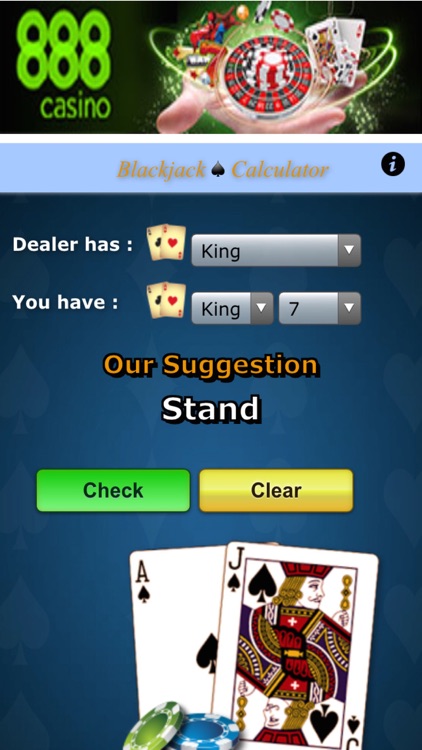
For the condition you specifiy, the expected return for standing is -0.1672, and the expected return for hitting is -0.3214. So it is clear that the correct play is to stand, and the difference is significant. Also consider the case of a 16 against a face card. Standing yields -0.5405, while hitting yields -0.5398. So the correct play is to hit, but you can see that this decision really doesn't make that much of a difference.
Very cool - I especially enjoy the spreadsheet. THANKS!
Try to do this simple problem on a spreadsheet.
From the Wizard's spreadsheet for an infinite deck extract the computation that comes up with the calculation dealer 7, player 17,if you stand you should have an expected value of -0.1068. Although that is a negative E.V., the alternatives are worse (hitting, doubling, or surrender=-0.500).
Now assume a single deck, and try to get the following E.V. if the player stands:
dealer 7, player has a 9 & 8 for a sum of 17. E.V.=-0.122900
dealer 7, player has a 10 & 7 for a sum of 17. E.V.=-0.121287
In this particular case it won't matter if the rule for the dealer is 'stand on soft 17' or 'hit on soft 17'
You will be surprised at how many rows of calculations you need for this relatively simple case. The mathematics is tedious, but it isn't brain surgery. But just start at this one case, and you will see how the calculations are derived.
Counting theory is a matter of getting every single possibility, and counting the ones you win versus the ones you lose.
Just say what is the probability of the dealer down card being a 10. If this happens then the hand is a push
For an infinite deck the odds are 4/13 .
For a single deck the odds are 16/49 for the first case since there is a 7, 8 and 9 out of the deck.
For a single deck the odds are 15/50 for the 2nd case since there is a 7, 7 and 10 out of the deck.
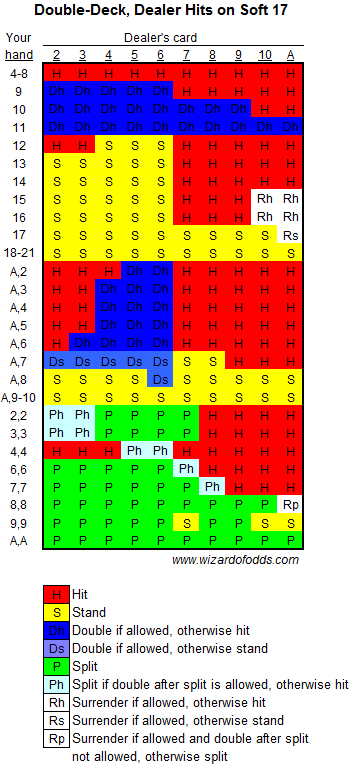
Even if you are going to program the solution, you should work out at least one case by hand, and it will give you a check to test out your algorithm,
I understand the BJ Basic Strategy, but I would like to see the probabilities behind each stratetgy, and (hopefully) a reasonable calculation method for these probabilities. For example, if I have a 14-count, and the dealer is showing a '5', the basic strategy says to 'stay' (and I do this ALL the time when I play). I understand this to mean that I have a higher probability winning the hand by staying (hoping that the dealer will bust), than by hitting. But what is the probability of the dealer busting, when showing a '5', and how is this calculated? Versus, what is the probability of me improving my hand by hitting (this is actually pretty easy to calculate)? And this is an easy case. Or have these probabilities really just been estimated by Monte Carlo type simulations?
The way I did it (BTW, I have a thirty-year-old degree of my own, in Computer Science, and have a strong math background) was:
First, for each combination of number of decks and whether the dealer hits or stands on soft 17, I went through every possible deal of cards from a full deck for the dealer's hand to determine the probabilities of getting 17, 18, 19, 20, 21, or bust for each up card value.
Then, to calculate the player's strategy, for each of the ten upcard values, I started with 'hit or stand on hard numbers', starting with 21. If you stand on 21, your expected win = the probability of the dealer getting 17 through 20 or busting; if you hit 21, your expected win = 1/13 x (your expected win with 22) + 1/13 x (your expected win with 23) + ... + 4/13 x (your expected win with 30). Of course, all of those 'expected win' values are -1. If the 'expected win by staying' > the 'expected win by hitting', you stay; otherwise, you hit.
Do the same thing with 20, then 19, then 18, and so on down to 12. (You work from 21 down because you have to know the 'expected win' values for all values that are higher than the one you are working on.)
You then work on soft 21 through soft 12, then 11 through 4.
Note that there is a slight fudge - if the dealer's up card is, say, 5, then you shouldn't multiply the value you get if you draw a 5 by 1/13 as there aren't necessarily as many 5s in the deck as there are other cards.
These are the same calculations that the Wizard does in his spreadsheet in Appendix 1 of the WOO Blackjack section. I tried very hard to simplify the equations used so that they are relatively uniform. The same numbers are in the Wiz's spreadsheet, but he didn't try as hard to use fewer formula, and he has some bookkeeping to invert matrices and other things. I am hopeful you will find mine a little easier to follow.
But I only started the problem, I didn't finish it.