Seat 1: OLD TIME GIN (603,237 in chips) $3.5 million in PokerStars cashes Seat 2: lbd.pkr (1,281,919 in chips) WCOOP 2017 finalist Seat 3: I'amSound (229,032 in chips) past SCOOP-Medium champ Seat 4: Juanki 'B4NKR0LL3R' Vecino (1,406,194 in chips) finished seventh in the Winter Series Main Event last month Seat 5: Internett93o (875,610 in chips) past Sunday Million winner. Gin Mill Card Club, Lubbock, Texas. 1,167 likes 8 talking about this 141 were here. We are Lubbock's Premier LEGAL place to play poker. PROUD MEMBERS OF THE LUBBOCK CHAMBER OF COMMERCE. Poker life has a lot of boring moments. I don't know if improving my gin game really helps my poker game, but anything the stimulates the mind can't hurt. I find the runs against the program and how games play out to often mimic how my poker play goes. That is when I'm tired and do sloppy things I. Vintage Fleischmann's Gin Poker Playing Cards Unopened. Vintage Fleischmann's Gin Poker Playing Cards. Vintage Fleischmann's Gin Poker Playing Cards New. Wembley Casino Lounge Playing Cards 50’s Dealer Deck Poker Vintage. Play Gin Rummy card game for free in your desktop or mobile browser.
On This Page
Introduction
Gin and Win is a table game based on the card game gin. Marketed by AGS, it made its Nevada casino debut in a field trial at the Golden Nugget in Laughlin in March, 2018. The bottom line is a house edge on the base game of 2.51% and an element of risk of 1.49%.
Rules
Following are the rules as given to me by AGS, the game distributor. I have an unconfirmed report that at the Golden Nugget they are following slightly modified rules, specifically on the dealer qualifying point and the Gin Bonus side bet.
For those unfamiliar with the game of gin, the object is to create an ten-card hand composed entirely of cards in sets. Qualifying sets in gin are at least three of the same rank and a suited run of cards, or straight flush, of at least three cards in length. Aces are low only. Cards that do not belong in a set are called 'dead wood.' When a player wins, he will get points in accordance to how much dead wood his opponent has.
The object of trying to put as many cards as you can in sets, with the goal of minimizing dead wood, is also the goal of Gin and Win. It should be emphasized that pairs and flushes of at least three cards count as sets in Gin and Win. The full rules are as follows:
- Cards are ranked as in poker, except aces are low only.
- To begin, each player must post an Ante bet. He may also wager on the optional Gin Bonus side bet.
- The player and dealer are each dealt seven cards, face down.
- The player looks at his hand and removes any combinations of pairs, trips, and quads (rank melds), or any flushes of three cards or more cards (suit melds). One card cannot be part of more than one set.
- The remaining cards are known as 'Dead Wood' and are set apart from the cards that belong to a set.
- The player must next either match his Ante with a Play wager equal to his Ante, or else fold his hand. Folded hands immediately lose, and Antes are collected by the Dealer.
- Once all action is complete, the dealer reveals his hand. The dealer forms the optimal rank and suit melds to minimize his remaining Dead Wood cards. Given multiple ways to achieve the same minimum number of remaining Dead Wood cards, the dealer will chose the way that minimizes the highest card.
- The dealer qualifies with three or less Dead Wood cards, or with four Dead Wood cards, all ranked ten or lower.
- If the dealer doesn’t qualify, then the player automatically wins even-money on his Ante, and the play bet pushes.
- If the dealer qualifies, then the player and dealer hand will be compared, and hand with fewer Dead Wood cards wins. If the Player and Dealer have the same number of Dead Wood cards, then the hand with the lower highest card wins. If that does not break the tie, then the second highest cards will be compared, and so forth until the tie is broken, unless the number and ranks of the Dead Wood cards are exactly the same.
- If the player wins the comparison with zero cards, then the Ante bet pays 3 to 1. Otherwise, if the player beats the dealer with one or more cards, then the Ante bet pays 1 to 1.
- If the two hands are equal, both bets push.
- If the dealer wins the comparison, both the Ante and Play bets lose.
- The optional Gin Bonus side bet is resolved based only the player's cards, according to the pay table below.
Following is the Gin Bonus pay table. All wins are on a 'to one' basis.
Gin Bonus Pay Table
| Event | Pays |
|---|---|
| 4-of-a-Kind & 3-of-a-Kind | 500 |
| 5-Card Flush & Pair | 20 |
| 4-of-a-Kind & 3-Card Flush | 8 |
| Other “Gin” Hand (No Deadwood) | 4 |
| One Deadwood Card | 2 |
| Two Deadwood Cards (both seven or lower) | 1 |
Strategy
The player should make the Play bet with a hand of 10-9-5-4 or better. In other words, three or fewer Dead Wood cards, or four ranked 10-9-5-4 or better. Note that is almost the same as the dealer qualifying strategy.
Ante and Play Analysis
According to the math report by GLI, the house edge, as defined as the ratio of the expected loss to the Ante wager, is 4.31%. The player will raise 68.36% of the time, for an average final wager of 1.6836 units. The element of risk, defined as the ratio of the expected player loss to the average total amount bet, is 2.56%.

Sorry, I don't have any more details than that.
Gin Bonus Analysis
The following table shows the analysis of the Gin Bonus bet. The lower right cell shows a house edge of 7.19%.
Gin Bonus Analysis
| Event | Pays | Probability | Return |
|---|---|---|---|
| 4-of-a-Kind & 3-of-a-Kind | 500 | 0.000005 | 0.002295 |
| 5-Card Flush & Pair | 20 | 0.002424 | 0.048476 |
| 4-of-a-Kind & 3-Card Flush | 8 | 0.018344 | 0.146756 |
| Other “Gin” Hand (No Deadwood) | 4 | 0.019960 | 0.079840 |
| One Deadwood Card | 2 | 0.151767 | 0.303533 |
| Two Deadwood Cards (both seven or lower) | 1 | 0.077350 | 0.077350 |
| All other | -1 | 0.730150 | -0.730150 |
| Total | 1.000000 | -0.071900 |
Acknowledgements
I would like to thank AGS, the game distributor, for sharing the math report by GLI with me.
External Links
- AGS — Official web site from the game distributor, AGS.
- Wizard of Vegas — Discussion about Gin and Win.
Written by:Michael Shackleford
| Origin | United States |
|---|---|
| Alternative names | gin, knock poker, poker gin, gin poker |
| Type | Matching |
| Players | 2 |
| Skills required | Memory, tactics, strategy |
| Cards | 52 |
| Deck | French |
| Play | Clockwise |
| Card rank (highest first) | K Q J 10 9 8 7 6 5 4 3 2 A |
| Playing time | 15 min. |
| Random chance | Low |
| Related games | |
| Conquian, American Mahjong, Desmoche, Rummy, Viennese Rummy | |
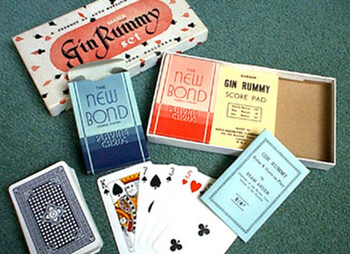
Gin rummy, or simply gin, is a two-player card game created in 1909 by Elwood T. Baker and his son C. Graham Baker.[1] It is a variant of rummy. It has enjoyed widespread popularity as both a social and a gambling game, especially during the mid twentieth century, and remains today one of the most widely-played two-player card games.
History[edit]
Magician and writer John Scarne believes gin rummy to have evolved from 19th-century whiskey poker (a game similar to Commerce, with players forming poker combinations[2]) and to have been created with the intention of being faster than standard rummy but less spontaneous than knock rummy.[3]
David Parlett finds Scarne's theory to be 'highly implausible', and considers the game of Conquian to be gin rummy's forerunner.[2]
Deck[edit]
Gin rummy is played with a standard 52-card pack of cards. The ranking from high to low is King, Queen, Jack, 10, 9, 8, 7, 6, 5, 4, 3, 2, Ace.
Objective[edit]
The objective in gin rummy is to score points and reach an agreed number of points or more, usually more than 100, before the opponent does.
The basic game strategy is to improve one's hand by forming melds and eliminating deadwood. Gin has two types of meld: Sets of 3 or 4 cards sharing the same rank, e.g. 8♥8♦8♠; and runs of 3 or more cards in sequence, of the same suit, such as 3♥4♥5♥ or more. Deadwood cards are those not in any meld. Aces are considered low—they can form a set with other aces but only the low end of runs (A♠2♠3♠ is a legal run but Q♠K♠A♠ is not). A player can form any combination of melds within their hand; all sets, all runs, or some sets and some runs.
The deadwood count is the sum of the point values of the deadwood cards—aces are scored at 1 point, face cards at 10, and others according to their numerical values. Intersecting melds are not allowed; if a player has a three-card set and a three-card run sharing a common card, only one of the melds counts, and the other two cards count as deadwood. For example; within the five cards 7♣7♠7♦8♦9♦, the seven of diamonds can be included in the set (7♣7♠7♦) or included in the run (7♦8♦9♦), but it cannot be included in both.

Dealing[edit]
Gin Poker Game
Dealership alternates from round to round, with the first dealer chosen by any agreed upon method. The dealer deals 10 cards to each player one at a time starting with their opponent, and then places the next card in the deck face up. This begins the discard pile. The face down pile is known as the stock pile.
Playing[edit]
Old Time Gin Poker
On the first turn of the round, the non-dealing player has first option of taking the upcard on the discard pile or passing. If the non-dealing player takes the upcard, they must then discard a different card to the discard pile. The player acting second can take the top card from the pile of their choice. However, if the non-dealing player passes the upcard, the dealer is given the opportunity to take the upcard or pass. If the dealer also passes, the non-dealing player must draw from the stock pile, then the next turn and after, players can draw from the pile of their choice.
On each subsequent turn, a player must draw either the (face-up) top card of the discard pile, or the (face-down) top card from the stock pile, and discard one card from their hand onto the discard pile.
Players alternate taking turns until one player ends the round by knocking, going Gin, or until only two cards remain in the stock pile, in which case the round ends in a draw and no points are awarded. The game ends when a player reaches 100 or more points (or another established amount). In tournament rules the game is played in best of five with 250 points per game.[4]
Knocking[edit]
In standard gin, only a player with 10 or fewer points of deadwood may knock. Knocking with 0 points of deadwood is known as going Gin or having a Gin hand, while knocking with deadwood points is known as going down.[5]
To knock, the knocking player discards as usual, announces knocking (generally by simply placing a discard face down), and the hand is laid out with the melds clearly indicated and deadwood separated. The other ('defending') player is then entitled to lay out any melds in their hand and can then lay off any of their remaining deadwood cards that fit into the knocking player's melds, provided that the knocking player does not have a gin hand.
For example, the knocking player has a meld of three Kings. The defending player's deadwood has a king. The player can lay off that king, reducing the deadwood count by ten. The knocking player can never lay off their deadwood into the defending player's melds. Once a player knocks or declares gin the round is over and scores are tallied, players cannot draw.
The knocking player then subtracts their deadwood points from the defending player's deadwood points. The result is the number of points the knocking player receives. An undercut occurs if a player knocks and the defending player's deadwood points are less than or equal to the knocking player's. In this case the defending player receives an undercut bonus (usually 25 points) plus the difference in deadwood points. If the defending player has less or equal deadwood to the knocking player's deadwood after laying off any of their deadwood, then it is still a valid undercut.
Gin[edit]
If all 10 cards in a player's hand fit into melds and thereby the player has no deadwood, they can choose to go Gin in which case the round ends and the player going Gin receives a Gin bonus of 25 points (or another established amount) plus any deadwood points in the opponent's hand. The defending opponent can only lay out their melds and cannot lay off any deadwood into the melds of an opponent that has declared Gin. A player can go Gin with a hand of three or fewer melds as long as all cards fit into a meld. Players can also have an 11 card gin, see Big Gin Variant below.
Big Gin[edit]
Gin hands normally consist of 10 cards. However, if a player chooses to draw so that 11 cards fit into melds, they can declare Big Gin in which case the player receives a Big Gin bonus of 31 points (or another established amount, commonly 50 points instead of the standard 31 points, depending on rule set) plus any deadwood in the opponent's hand.
Scoring[edit]
Aces are scored at 1 point, face cards at 10, and all other cards are scored at their numerical values. The number of points awarded for bonuses may vary from region to region. No matter what the bonus amounts are, points are scored in Gin for the following:
- Knock points
- After a player knocks, and the layoffs are made, the knocking player receives a score equal to the difference between the two hands. For example, if a player knocks with 8, and the defender has 10 deadwood points in their hand after laying off, the knocking player receives 2 points for the hand. If a player is able to knock before any cards are accepted, it is considered a misdeal.
- Gin bonus
- After going gin, a player receives a bonus of 25 points plus the entire count of deadwood in the opponent's hand. There is no chance to lay off when a player goes gin.
- Undercut (or underknocking)
- Occurs when the defending player has a deadwood count lower than or equal to that of the knocking player (this can occur either naturally or by laying off after a knock). In this case, the defender scores an undercut bonus of 25 points plus the difference in deadwood in the knocking player's hand. (In some rule sets, the bonus is only 10 or 20 points, or is not awarded in case of a tie.)
- Game bonus
- Once a player has acquired 500 points (or some other agreed-upon number) the game is over, and that player receives a game bonus of 100 points (or another agreed-upon number).
- Line bonus or box bonus
- Added at the end of the game. For every hand a player won during the game, 25 points is added to their score.
- Big gin
- Prior to knocking, if all 11 cards in a player's hand form a legal gin, the player can retain the extra card as part of their hand, and is awarded 31 points plus entire count of deadwood in their opponent's hand. (In some rule sets players may be awarded 50 points or another established amount plus the entire count of deadwood in the opponent's hand)
- Shutout bonus
- If a game is completed with the winner having won every hand, the points for each hand are doubled before adding the line bonus.
In some variations, if the winning player beats the losing player by exactly 50 points, the winning player must forfeit the match.
Variations[edit]
Straight gin[edit]
In straight gin, players are required to play until one of them can go gin. Knocking is not allowed. Scoring and rules remain the same as standard gin rummy.
Mahjong gin[edit]
Similar to straight gin, knocking is not allowed. However, more than one card may be taken, in order, from the top of the discard pile. If more than one card is taken, the lowest position card taken must be used in a hand: e.g. <bottom> 8♠3♥5♥ <top of discard> 8♠ is the lowest position card and must be used in a hand; continue with one discard). Cards are shown to the table, with opponents being able to add on to straights of the same suit or finish a three of a kind with the fourth card for points. After a player has gin, points are added, with cards on the table being added up and cards in hand being subtracted. The player who gins receives 25 additional points, 2 through 9 = 5 points, 10 through K = 10 points, A = 15 points.
Oklahoma gin[edit]
In this version of gin rummy, the value of the first upcard is used to determine the maximum count at which players can knock. If the upcard is a spade, the hand will count double. So if the first upcard was a 4, you can knock and go out with only 4 or fewer points in your hand; and if the card was 4♠, you would get double points that hand.
Another version in this variation (mostly in match play) and in Hollywood gin (see below), a second deck of cards will be used to determine the knock value of a hand. The knock value card will be dealt from the bottom and turned over on top. Above rules apply but both players are dealt ten cards with the last hand winner picking first from the deck.
Poker Gin Card
Hollywood gin[edit]
This is a scoring style, not a rules change to the game of gin. In Hollywood gin, scoring is kept for three different games at the same time. A player's first win will be recorded in their column in Game One. A player's second win will be recorded in their columns for both Game One and Game Two. Their third win will be recorded in their column for all three games. Hands are played until all three games are finished.
Tedesco gin[edit]
Similar to Oklahoma gin, except aces can be used high or low, and runs can be formed 'around the corner' (such as K♠A♠2♠). If you are caught with an unmelded ace, it counts as 15 points against you. Hollywood scoring of three games to 200 when playing head-to-head or with two-person teams. Three-person teams play to 300, 25 points extra if all three teammates win. 50 points for four-person team, etc. This is a more complex gin game for all levels of player.
Single match[edit]
When a single match is to be played, the players will continue to play rounds until one player has 100 points or more. This player wins the match.
Multi-match[edit]
In multi-match games, match scores are reset to zero with the start of each match, while game scores accumulate until a predetermined winning score is reached, perhaps 500 or higher. Each individual match ends when one player scores 100 match points. At the end of the match, players' match scores are credited toward their game scores, as well as:
- 25 game points for each individual round won,
- 100 game points to the winner of the match, and
- 100 bonus game points to the match winner if the loser won no rounds.
Notable players[edit]
- Stu Ungar, widely regarded as the greatest gin rummy player of all time, was described by many as having a near clairvoyant ability to see his opponents' hands. Ungar's almost total dominance of the game during the 1970s and 1980s is thought to have been a factor in the decline of gin rummy as a tournament game in Las Vegas and other gambling venues. (Ungar eventually switched to poker.) [6][7]
- Oswald Jacoby, best known as a contract bridge and backgammon champion, also played high-stakes gin rummy and wrote several books on the game.
- Ernie Kovacs, the comedian and television pioneer, published a book in 1962 called How to Talk at Gin.
- Fictional characters
- The villain Auric Goldfinger cheats at gin rummy in the key introduction scene of the James Bond film Goldfinger (1964), with the help of an accomplice looking at the opponent's cards through binoculars.[8] The film script changed the game to gin rummy from two-handed Canasta in the source novel by Ian Fleming.
See also[edit]
References[edit]
- ^'C.G. Baker, Helped Devise Gin Rummy'. New York Times. May 17, 1950. Retrieved May 22, 2008.
C. Graham Baker, writer and producer of motion pictures and co-creator of the card game gin rummy, died today at his home in Reseda in the San Fernando Valley. ...
- ^ ab'Parlett's Historic Card Games: Gin Rummy - David Parlett'.
- ^Scarne, John (2008). Scarne on Card Games: How to Play and Win at Poker, Pinochle, Blackjack, Gin and Other Popular Card Games. Courier Dover Publications. p. 37. ISBN978-0-486-43603-6.
- ^Hainline, John; Hainline, Lily Ann (2018). 'Gin Rummy Rules for Tournament Play'(PDF). ginrummytournaments.com. Palm Desert: Gin Rummy Association. Retrieved April 11, 2018.
- ^'Glossary of gin rummy terms'. rummytalk.com.
- ^Ungar, Stu (June 29, 2006). One of a Kind: The Rise and Fall of Stu Ungar (documentary). USA: Szymanski, Al.
- ^Michael Konik (April 1, 1999). 'The Gin Mill'. Cigar Aficionado. Retrieved July 18, 2012.
- ^'Goldfinger (1964) - Miami hotel pool scene'. Retrieved July 18, 2019 – via YouTube.
External links[edit]
- Rules of gin rummy at Pagat.com